


Key takeaways:
- Price, not efficacy, is driving growth in the market – compounded GLP-1s are gaining ground because they’re cheaper, not because they work better.
- The shift isn’t hitting your whole customer base evenly – effectiveness (and likely behavioural change) is lower among adults 65 and over.
- Usage has nearly quadrupled in two years with no sign of plateauing, so this is a trend with runway left, not one that’s peaked.
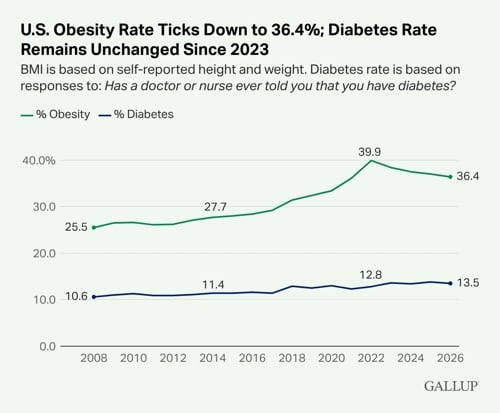
America’s obesity rate has fallen – not by a rounding error, but from 39.9% in 2022 to 36.4% in 2026. Over the same period, the number of US adults taking a GLP-1 drug for weight loss has risen sharply, according to a new Gallup poll: one in nine adults is now on a GLP-1, up from one in 33 just two years ago.
Those figures suggest the weight-loss drugs are having a measurable impact, and that the food industry’s biggest customer base is eating differently.
Gallup surveyed 5,065 US adults for the poll, conducted between 28 May and 5 June 2026 as part of its ongoing National Health and Well-Being Index. It found that 11% currently take a GLP-1 medication for weight loss, up from 3% in 2024, while 15% have taken one at some point, an increase of nine percentage points. Awareness has also grown fast: 91% of adults now know GLP-1s can be used for weight loss, up from 80% two years ago.
Correlation isn’t proof, and scientists are right to note that obesity is shaped by income, genetics, activity levels and policy as well as medication. But the timing is hard to dismiss, and it isn’t only a US story. A separate analysis published in Nature this year by the NCD Risk Factor Collaboration found that obesity’s decades-long rise is now plateauing across developed nations, even as it continues to accelerate in developing ones.
Majid Ezzati, Professor of Global Environmental Health at Imperial College London, presented related findings at the European Congress on Obesity in May. “We’ve been analysing obesity trends for decades and have shown that on the whole, obesity has increased – with more people being affected by overweight and obesity,” he said. “This latest analysis suggests that the rate of growth in obesity is slowing and stabilising, and may even be reversing, in many countries. Ultimately, this analysis shows that the trend towards obesity is not inevitable, and that it is possible for policymakers to intervene to stop and even reverse growing obesity.”
Manufacturers, however, don’t need a settled scientific consensus or policy intervention to act. What matters is that the picture has changed for the first time in living memory – and the Gallup data offers a useful, granular look at exactly how.
Inside the Gallup numbers
The headline figures are striking, but the detail underneath them is arguably more useful for manufacturers trying to plan ahead.
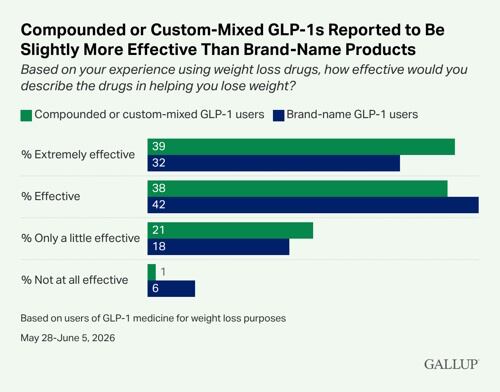
Cost, not efficacy, is driving the biggest structural shift in the market. Brand-name GLP-1s such as Ozempic, Wegovy, Mounjaro and Zepbound still account for 68% of current use, but compounded or custom-mixed versions – unapproved by the FDA – now make up 19%, with a further 12% of users unsure which type they’re taking. The FDA has warned that compounded drugs aren’t reviewed for safety, but that hasn’'t slowed uptake. Compounded users report the medicines work at least as well: 39% describe them as ‘extremely effective’, compared with 32% of brand-name users, though the two groups converge when ‘effective’ responses are included – 77% versus 74%.
More significant for manufacturers is which way users are moving between the two. Current compounded users are far more likely to have switched from a brand-name drug than the reverse – 35% compared with just 10%. Among those who switched to compounded versions, two-thirds cited cost as the primary reason and the remainder pointed to gaps in insurance coverage, versus just over a third citing cost among those who switched back to branded drugs. In short: price is pulling a growing share of users toward cheaper, less regulated options, and that migration looks set to continue as affordability remains the binding constraint on the market, not demand.
If access were the only barrier, cheaper compounded options widening the funnel means the 11% current-use figure is more likely to keep climbing than to plateau.
The US adult diabetes rate has held steady since 2023, following 15 years of gradual increases that tracked rising obesity. Gallup notes this is broadly what would be expected: a falling obesity rate is expected to stabilise the diabetes rate over time, rather than reduce it immediately, since diabetes is a lifetime condition that can be managed but not cured. The flattening is nonetheless the first meaningful break in a 15-year trend, and Gallup links it to the same GLP-1 usage curve driving the obesity decline.
One demographic nuance worth flagging for manufacturers is thinking about which categories or channels to prioritise. Gallup’s research found a general alignment between GLP-1 usage and falling obesity rates across most age groups, with one notable exception: adults aged 65 and over, for whom reported effectiveness of the drugs is lower.
That suggests the shift in eating behaviour associated with GLP-1s is currently concentrated in working-age and younger-retirement consumers, rather than evenly spread across the population – a distinction that’s notable for anyone segmenting product development or marketing by age group.
Don’t panic, adapt
The picture is one of an addressable market that’s still growing; still shifting in composition; and increasingly price sensitive.
Brand-name drugs remain dominant for now, but the compounded segment is where the momentum sits. As Gallup warns, broader – though still limited – access to lower-cost options “may be what’s driving GLP-1 usage higher overall”.
For manufacturers, that points to a trend with further room to run rather than one that has already peaked.
None of this is cause for alarm, however. Food categories have a long history of adapting to disruption rather than being wiped out by it – low-carb diets didn’t end bread, sugar taxes didn’t end soft drinks, and plant-based eating didn’t end meat. Each shift forced reinvention and created new opportunities for those who moved early.
GLP-1s look likely to follow a similar path, and with usage still climbing and cost barriers still falling, manufacturers have time to plan rather than panic – but not an unlimited amount of it. The sensible response is to start now: building for a customer who eats less, expects more from every purchase, and whose numbers are still growing.
Study:
NCD Risk Factor Collaboration (NCD-RisC). Obesity rise plateaus in developed nations and accelerates in developing nations. Nature 653, 510–518 (2026). https://doi.org/10.1038/s41586-026-10383-0


